
Why I Finally Moved My Websites Away From Bluehost
Technology / Using
What started as an easy, affordable hosting solution eventually stopped fitting the way I build and manage websites. Here’s why I moved on, what I learned, and what I look for in a web host today.

By Luis Alvarez · Updated October 2026
Key Takeaway
Bluehost wasn’t necessarily a bad place for me to start. It was easy to get into, WordPress was familiar, and for relatively simple websites it did what I needed it to do.
The problem was that my needs changed.
As I began managing more websites, experimenting with newer WordPress tools, and paying closer attention to performance and the overall management experience, I found myself working around my hosting more often than I wanted to.
Eventually, moving became less about finding a “better” hosting company and more about finding a hosting environment that better matched how I work today.
1. Why I Chose Bluehost in the First Place
Like a lot of people building WordPress websites, I originally chose Bluehost because it was everywhere.
It was affordable, WordPress-friendly, relatively easy to understand, and constantly appeared in hosting recommendations. When you're getting started, those things matter.
At the time, I wasn't particularly interested in becoming an expert in hosting infrastructure. I wanted a place where I could register a domain, install WordPress, create email accounts, and start building.
Bluehost checked those boxes.
And for a while, that was enough.
This is an important part of the story because I don't think every technology decision needs to be permanent. A tool can be the right choice at one stage and the wrong choice several years later.
That's essentially what happened here.

2. My Websites Changed — and So Did My Expectations
Over time, websites became much more than something I occasionally worked on.
I manage websites professionally, work with WordPress regularly, experiment with different builders and platforms, and maintain several of my own projects.
That changed what I expected from hosting.
I wasn't simply looking for somewhere to put a WordPress installation anymore. I wanted an environment that made it easier to manage multiple websites, domains, SSL certificates, backups, staging, performance, security, and the other pieces that come with modern website management.
I also started paying much more attention to the experience behind the website.
How quickly can I get to what I need?
How much control do I have?
How easy is it to create or migrate a site?
How much time am I spending navigating account screens instead of actually working on the website?
Those things may sound minor individually, but when you work with websites regularly, small amounts of friction add up.
3. The Problems Started to Add Up
There wasn't one catastrophic Bluehost failure that made me pack everything up overnight.
It was cumulative.
The hosting environment increasingly felt like something I was adapting to instead of something that was helping me work.
A few issues mattered more than others:
The overall management experience felt more cumbersome than I wanted.
Performance became more important as my sites and expectations grew.
I wanted easier access to modern hosting and WordPress management tools.
Pricing mattered, but I was increasingly interested in the value I received beyond an introductory hosting rate.
I wanted an environment that better supported experimentation and multiple projects.
None of those necessarily makes Bluehost unusable.
They simply made me start asking a different question:
If I were choosing a host today, knowing what I know now, would I still make the same choice?
Eventually, my answer was no.
4. Price Isn't the Same Thing as Value
Hosting companies love introductory pricing.
It's one of the first things most of us look at when we're starting a website, and I was no different.
But I've learned to look at hosting costs differently.
The cheapest advertised monthly price doesn't tell you much by itself.
I now look at the complete package:
What happens when the introductory term ends?
How many websites can I realistically manage?
Are backups included?
How easy is staging?
How are SSL certificates handled?
What security and performance tools are included?
How much time does the control panel save me?
How easy will it be to move if my needs change again?
For someone maintaining a single basic website, some of these things may not matter much.
For me, they do.
My time has value too.
Saving a few dollars on hosting isn't particularly useful if I repeatedly lose that savings through additional management time or limitations.
5. I Started Looking at Hosting as Infrastructure
This was probably the biggest change in my thinking.
I used to think of hosting primarily as a website expense.
Now I think of it as infrastructure.
That distinction matters.
Hosting affects the environment where I build, test, maintain, secure, back up, and troubleshoot a website. It sits underneath almost everything else I'm doing.
The website builder gets more attention because that's the part we see. Plugins get attention because they add features. Design gets attention because that's what visitors experience.
Hosting mostly disappears into the background.
And that's exactly what I want it to do.
Good infrastructure shouldn't constantly demand my attention.
6. What I Switched To
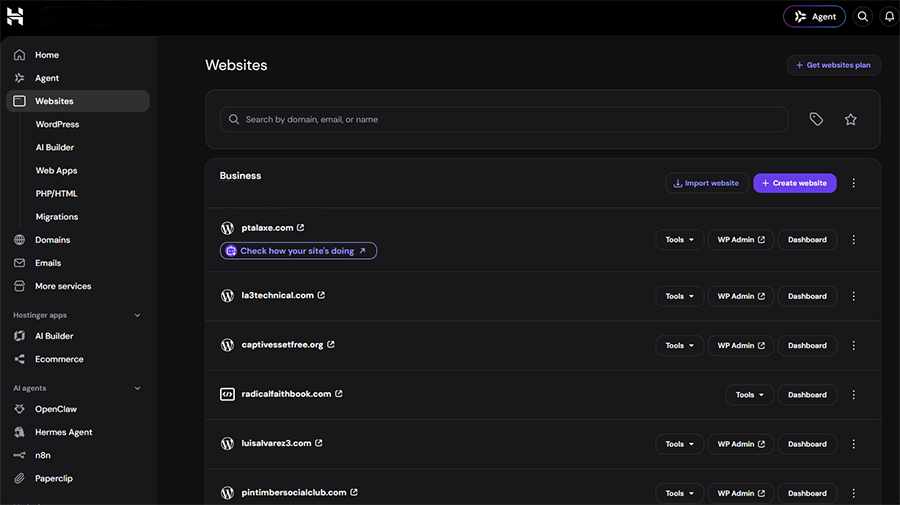
For several of my current projects, I've moved to Hostinger.
That includes the environment I'm using as I continue developing projects such as LuisAlvarez3.com and LA³ Technical.
The decision wasn't based on believing Hostinger is universally the “best” hosting company. I don't think there's a single best host for everyone.
It was about fit.
I liked the combination of website management, WordPress tools, pricing, and the general experience of managing multiple projects from one environment.
Most importantly, it felt closer to the way I wanted to work now.
There are other hosting providers I would consider depending on the project. A high-traffic ecommerce site, a small local-business website, a personal blog, and a business running mission-critical applications don't necessarily need the same hosting solution.
That's another lesson I've learned:
Choose hosting for the website you're actually building—not because a hosting company happens to be the most familiar name.
7. Moving Was Easier Than Staying Put Forever
Website migrations sound intimidating.
That's probably one of the reasons people remain with the same hosting provider for years.
Domains, DNS, databases, email, SSL, WordPress files and the possibility of downtime make moving feel risky.
That concern isn't unreasonable.
But modern migration tools and managed migration services have made the process much more approachable than it used to be.
The key is planning the move instead of rushing it.
Before migrating, I want to know where the domain is registered, where DNS is controlled, where email is hosted, whether the site has a current backup, what PHP and WordPress requirements exist, and whether anything outside the standard WordPress installation needs to move.
Separating those pieces also prevents one of the most common misconceptions about hosting:
Your domain, website hosting, DNS and email don't necessarily have to live with the same company.
Understanding that gives you considerably more flexibility.
8. What I Would Do Differently Today
If I were starting my first website again, I wouldn't spend weeks comparing every hosting company.
But I also wouldn't choose one simply because it appears at the top of every “Best WordPress Hosting” article.
I'd start with a few practical questions.
How many websites do I expect to operate?
Am I comfortable managing WordPress myself?
Do I need business email?
Do I need staging?
How important are automatic backups?
Am I likely to run ecommerce?
How much traffic do I realistically expect?
Do I want the simplest possible experience, or more technical control?
And perhaps most importantly:
What will this cost after the promotional period ends?
Those answers would narrow the choices much faster than comparing feature lists containing things I might never use.
9. Bluehost May Still Be Fine for Some People
Moving away from a service doesn't mean I think everyone else should leave it.
For someone building a first WordPress site who wants a recognizable platform and a relatively straightforward entry point, Bluehost may still make sense.
My experience is simply that I outgrew what I wanted from that environment.
That's an important distinction.
Technology recommendations become much more useful when we stop treating products as universally “good” or “bad.”
The better question is:
Good for whom, and for what?
My answer changed as my experience and projects changed.
10. What I Look for in Hosting Now
Today, my priorities are clearer.
I want reliable performance, straightforward management, good backup options, useful WordPress tools, reasonable security features, transparent long-term costs, and an environment where managing several websites doesn't become a project of its own.
I also want portability.
I don't want any platform to become so intertwined with a website that leaving it feels impossible.
That applies to hosting, page builders, plugins, SaaS products and plenty of other technology.
Use the tools that make sense now—but understand how you'll get your data and your work out later.
Final Thoughts
Moving away from Bluehost wasn't really about Bluehost.
It was about recognizing that the way I work with websites had changed.
Something that served me reasonably well when my requirements were simpler wasn't necessarily the right environment once websites became a larger part of my professional and personal work.
That's probably the biggest lesson I've taken from the experience.
Don't stay with technology simply because it's what you've always used.
Every once in a while, step back and ask whether the tool still fits the job.
Sometimes the answer will be yes.
And sometimes realizing that the answer is no is exactly what pushes you toward a better setup.
On This Page
Why I Finally Moved My Websites Away From Bluehost
Enjoying This Article?
Get practical insights, project updates, and new articles delivered to your inbox.
Written by
Luis Alvarez
I'm Luis, the creator of LuisAlvarez3.com. I share what I'm building, learning, using, and exploring across technology, projects, and everyday life.
Related Reading

Technology / Using
Technology / Using
Recommended Tools
Hostinger
An agentic platform to build, run, and grow your business online, all in one place.
Obsidian
A notes app built around local Markdown files and linked ideas.
Notion
A workspace for notes, structured pages, and collaborative projects.
Affiliate Disclosure
Some links on luisalvarez3.com may be affiliate links. If you purchase through one of these links, I may earn a commission at no additional cost to you. Recommendations are based on my experience, research, or relevance to the topic—not simply whether a product offers an affiliate program.